
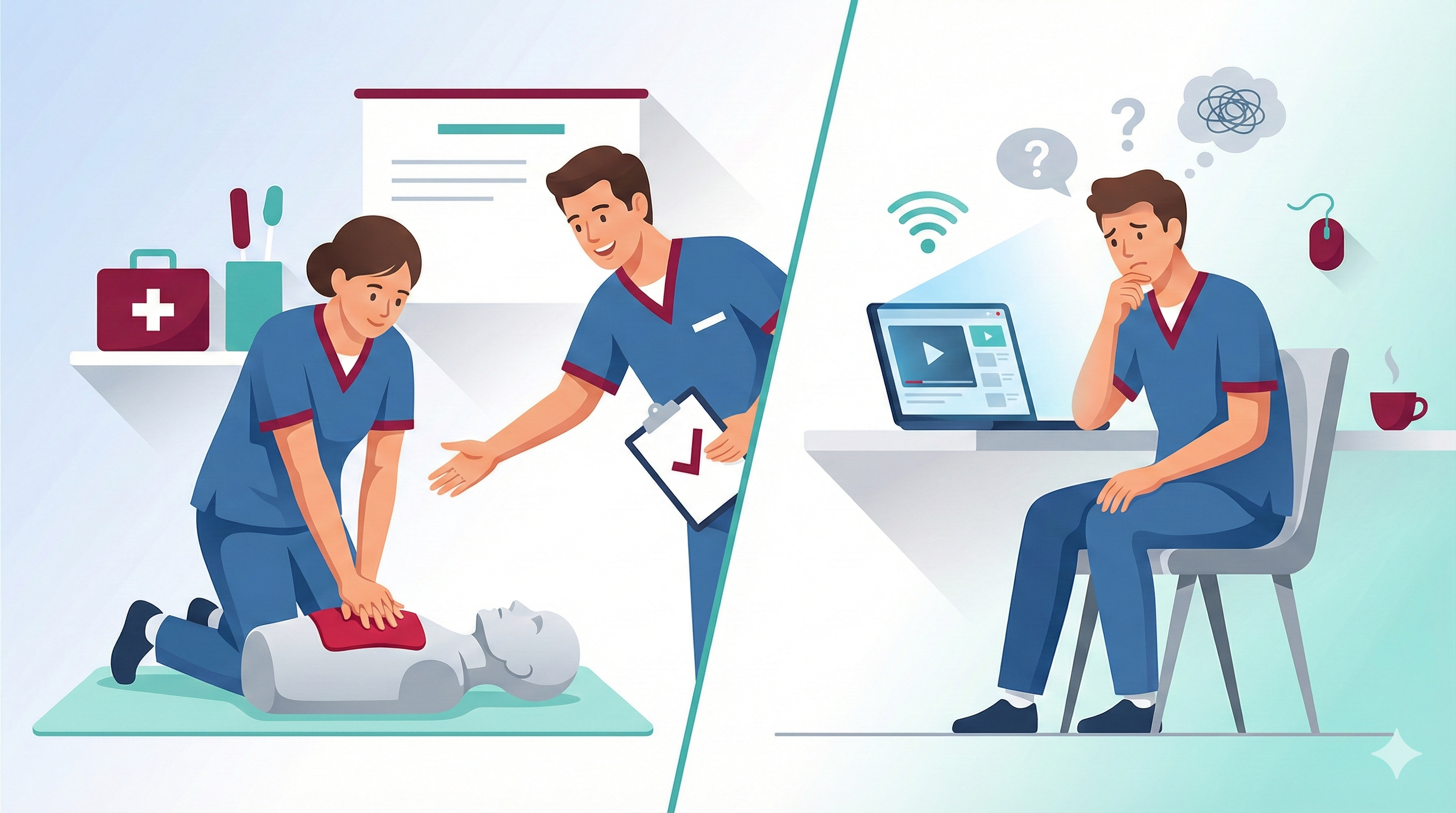
Picture this: You’re at a family barbecue when your uncle suddenly collapses. Someone yells, “Call 911!” and everyone turns to you because they know you’re “CPR certified.” Your hands are shaking. Your mind goes blank. That online course you took six months ago? It didn’t prepare you for this moment.
This scenario plays out more often than you’d think, and it highlights a critical truth about CPR training: certification cards don’t save lives—confident, competent responders do.
The Problem with 100% Online CPR Courses
The appeal of online-only CPR courses is obvious. You can complete them in your pajamas, skip through videos at 2x speed, and get your card in the mail without ever leaving home. It’s convenient, cheap, and checks the box for workplace requirements.
But here’s what online courses can’t provide: the muscle memory and hands-on experience that makes the difference between hesitation and action in a real emergency.
What You Miss Without Hands-On Practice
1. Proper Compression Depth and Rate
Reading that you need to compress “at least 2 inches deep at 100-120 compressions per minute” is very different from actually doing it. Most first-time students are shocked by how much physical effort quality CPR requires. Without an instructor watching and correcting your technique, you could be practicing improper form that won’t work in a real emergency.
2. AED Confidence
An Automated External Defibrillator can seem intimidating if you’ve only seen pictures of one. In-person training lets you actually open the device, place the pads, and follow the prompts. This hands-on experience eliminates the fear factor that causes bystanders to freeze when seconds count.
3. Real-Time Feedback
During in-person training, certified instructors immediately correct your hand placement, compression rate, and rescue breath technique. This instant feedback loop is impossible to replicate online. You might think you’re doing it right, but without an expert watching, you could be reinforcing bad habits.
4. Scenario-Based Learning
The best CPR courses incorporate realistic scenarios that prepare you for the chaos of actual emergencies. Practicing on a manikin while an instructor simulates a panicked bystander or coordinates with “arriving EMS” builds the mental preparedness that online courses simply cannot provide.
What the Science Says
The American Heart Association—the gold standard for CPR certification—has consistently emphasized the importance of psychomotor skill practice. Their research shows that students who complete hands-on training retain skills significantly longer and perform better in simulated emergencies compared to those who complete online-only courses.
In fact, the AHA requires hands-on skills testing even for their “Heartcode” blended learning courses. Why? Because they know that watching videos doesn’t translate to life-saving competence.
The Real-World Impact
As someone who’s been teaching CPR for over 30 years and responding to emergencies for 34 years as a firefighter, I’ve seen the difference firsthand. The people who save lives aren’t always the ones with the newest certification card—they’re the ones who’ve practiced chest compressions until their arms ached, who’ve worked through realistic scenarios, and who’ve had an experienced instructor tell them “Yes, you’ve got this.”
I’ve had students come back years later and tell me, “I used what you taught me. I saved someone’s life.” That feedback never comes from the shortcuts—it comes from the students who showed up, got on their knees, and did the work.
When Online Components Work
This isn’t to say online learning has no place in CPR training. Blended learning courses—where students complete knowledge portions online and then attend in-person skills sessions—can be highly effective. They combine the convenience of self-paced learning with the critical hands-on practice that builds true competence.
The key is that skills testing must always happen in person with a qualified instructor.
The Bottom Line
Your CPR certification is more than a card to satisfy an employer’s checkbox. It’s a commitment to being ready when someone’s life depends on your actions.
Yes, in-person training requires a few hours of your time. You’ll have to drive to a training center, kneel on the floor, and practice until you get it right. It’s less convenient than clicking through an online course.
But when you’re standing over someone who’s stopped breathing, you won’t care about convenience. You’ll care about competence. And that only comes from hands-on training with expert instruction.
Take the Next Step
Don’t settle for a certification that looks good on paper but falls short in real emergencies. Choose training that gives you the confidence and competence to act when it matters most.
Ready to learn life-saving skills the right way? Browse our American Heart Association-certified CPR and BLS courses, taught by instructors with real-world emergency response experience. Because when seconds count, proper training makes all the difference.
Ready to Get Certified?
From individual CPR to full ACLS/PALS provider courses, we have the class for you. Reach out today to book your spot or inquire about our on-site training options.

