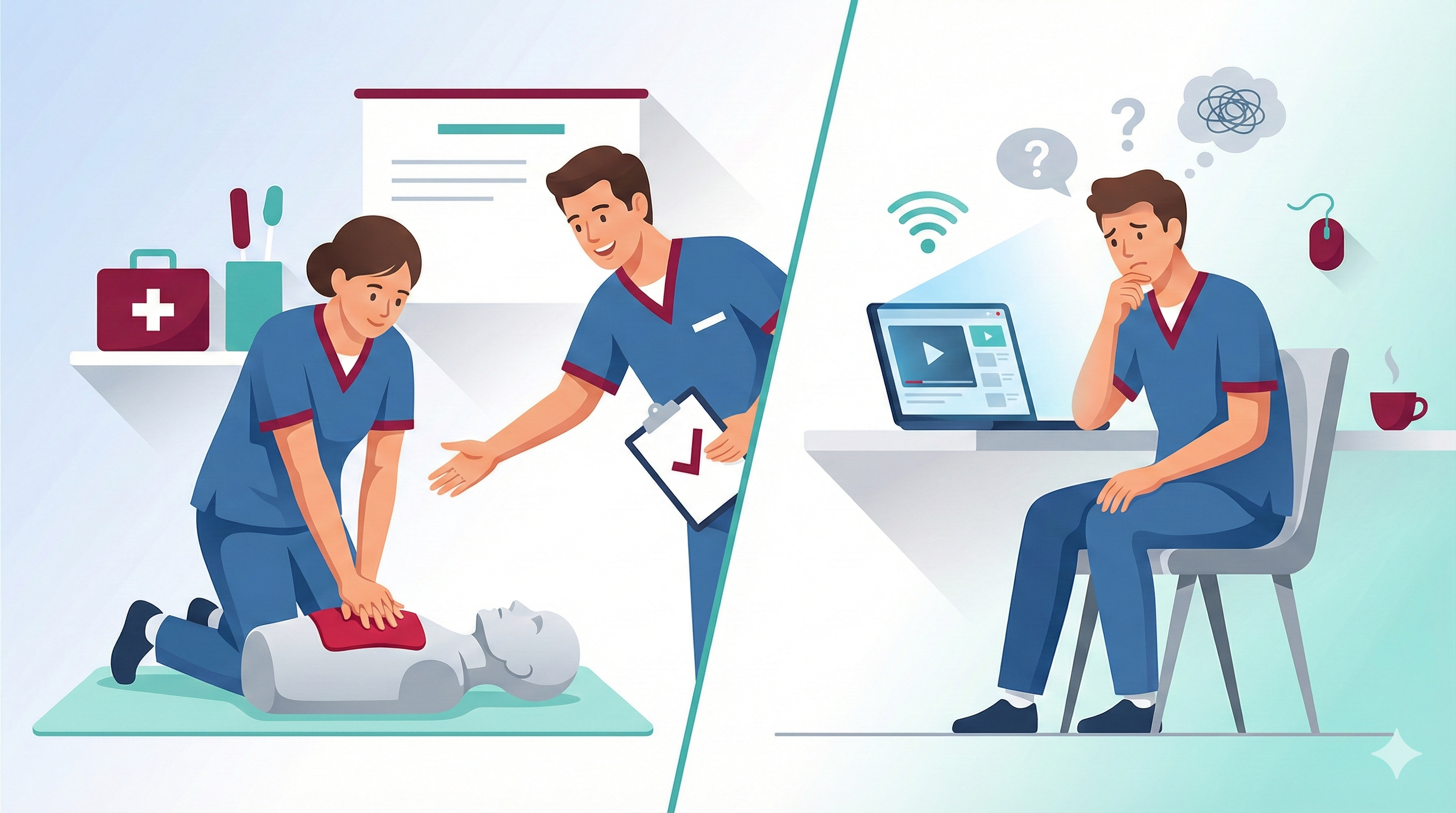
You’ve signed up for your ACLS (Advanced Cardiovascular Life Support) course. The exam is two weeks away. You open the precourse self-assessment, and suddenly you’re staring at rhythm strips that look like abstract art, medication dosages that blur together, and algorithms that seem impossibly complex.
Sound familiar?
After teaching ACLS for over 30 years, I’ve seen thousands of healthcare professionals walk through that door with the same worried expression. Many think they’ll need to memorize every detail of the massive provider manual. Others assume their clinical experience alone will carry them through.
Here’s the truth: ACLS isn’t about memorizing—it’s about mastering core concepts and systematic approaches. And with the right preparation strategy, you can pass confidently on the first try.
Understanding What ACLS Really Tests
Before we dive into study strategies, let’s clarify what the American Heart Association is actually evaluating:
Not This:
- Encyclopedic medical knowledge
- Every possible medication interaction
- Obscure cardiac conditions
- Perfect recall under pressure
But This:
- Systematic approach to cardiac emergencies
- Recognition of life-threatening rhythms
- High-quality CPR and team dynamics
- Appropriate use of ACLS algorithms
- Medication knowledge for core scenarios
The Key Insight: ACLS is algorithm-based. Master the algorithms, and you’ve conquered 80% of the exam.
Tip #1: Master the Core Algorithms (Not Memorize—MASTER)
The ACLS provider manual contains multiple algorithms, but five are absolutely critical:
- Cardiac Arrest (VF/pVT and Asystole/PEA)
- Bradycardia
- Tachycardia
- Acute Coronary Syndromes
- Stroke
How to Actually Master Them
Step 1: Understand the Logic
Don’t just memorize steps—understand WHY each intervention comes in that order.
Example: In the cardiac arrest algorithm, why do we do CPR before medications? Because blood flow is more critical than drugs. Understanding this makes the algorithm logical, not random.
Step 2: Use Visual Learning
- Print out algorithms and post them where you’ll see them daily
- Use different colors to highlight different pathways
- Draw the algorithms from memory, then check your work
- Create flowcharts that consolidate information
Step 3: Talk Through Scenarios
Explain the algorithms out loud to yourself, a colleague, or even your dog. Teaching forces deeper understanding.
“Patient presents in VF. First, we verify on monitor. Second, we start high-quality CPR. Third, we charge and deliver shock. Fourth, we immediately resume CPR for 2 minutes…”
Pro Tip: Create index cards with scenarios on one side and the appropriate algorithm pathway on the other. Quiz yourself during breaks.
Tip #2: Focus on High-Yield Medications
You don’t need to memorize every medication in the formulary. Focus on these high-impact drugs:
The Essential Six
Epinephrine:
- Dose: 1 mg IV/IO every 3-5 minutes during cardiac arrest
- Why it matters: Used in all cardiac arrest rhythms
Amiodarone:
- Dose: 300 mg IV/IO first dose, 150 mg second dose
- Why it matters: Primary antiarrhythmic in VF/pVT
Adenosine:
- Dose: 6 mg rapid IV push, then 12 mg if needed
- Why it matters: First-line for stable SVT
- Critical detail: Must be a rapid push followed by a flush
Atropine:
- Dose: 0.5 mg IV every 3-5 minutes (max 3 mg)
- Why it matters: Used for symptomatic bradycardia
Dopamine/Norepinephrine:
- Know when to use for bradycardia with hypotension
- Understand infusion range (not exact calculations for the exam)
Aspirin:
- Dose: 160-325 mg PO
- Why it matters: ACS treatment, seems simple but is often forgotten under pressure
Memory Trick: “EAA-DNA”
Epinephrine – Amiodarone – Atropine – Dopamine – Norepinephrine – Aspirin
Don’t waste time memorizing obscure medications. Master these six, and you’re covered for 95% of scenarios.
Tip #3: Rhythm Recognition—Quality Over Quantity
Many students stress about identifying every possible cardiac rhythm. Here’s the secret: ACLS only requires you to distinguish between a few critical categories.
The Four That Matter
1. Shockable Rhythms (VF/pVT):
- Chaotic, no clear QRS complexes (VF)
- Wide, rapid, regular rhythm (pVT)
- Action: Immediate defibrillation
2. Non-Shockable Rhythms (Asystole/PEA):
- Flatline (Asystole)
- Organized rhythm without pulse (PEA)
- Action: CPR and epinephrine
3. Too Fast (Tachycardia):
- Rate > 100 bpm
- Narrow or wide complex
- Stable or unstable patient
- Action: Follow the tachycardia algorithm
4. Too Slow (Bradycardia):
- Rate < 60 bpm
- With or without symptoms
- Action: Follow the bradycardia algorithm
Practical Study Method
Use Pattern Recognition:
- Spend 15 minutes daily looking at rhythm strips
- Focus on rate, regularity, and QRS width
- Practice identifying “shockable vs. not shockable” instantly
Free Resources:
- American Heart Association website
- ECG rhythm apps (many free options)
- YouTube channels dedicated to rhythm interpretation
Remember: You’re not training to be a cardiologist. You’re learning to make rapid, life-saving decisions.
Tip #4: Teamwork and Communication Aren’t “Soft Skills”
Here’s something many students overlook: ACLS is as much about team dynamics as medical knowledge.
The AHA emphasizes high-performance team behaviors:
What Instructors Are Watching
Clear Communication:
- Use closed-loop communication: “Give 1 mg epinephrine.” “Giving 1 mg epinephrine.” “1 mg epinephrine given.”
- Speak clearly and deliberately
- Confirm understanding
Defined Roles:
- Team leader coordinates, doesn’t do everything
- Clear assignment of tasks (airway, compressions, medications, etc.)
- No stepping on toes
Constructive Intervention:
- Speak up if you see errors
- Use respectful language: “I’m concerned about…” not “You’re wrong…”
Knowledge Sharing:
- Share information proactively
- Ask for help when needed
- Offer assistance when you see gaps
Practice Scenario:
During class simulations, don’t just go through motions. Practice being team leader. Practice being team member. Both require different skills.
Tip #5: Use the Pre-Course Work Strategically
The AHA provides pre-course self-assessment and learning modules. Most students either skip them entirely or try to cram everything the night before class.
Better Approach:
Two Weeks Before Class
Complete Precourse Assessment:
- Take it without looking anything up
- Note which areas you struggled with
- This tells you where to focus study time
Target Weak Areas:
- If you scored low on rhythm recognition, spend extra time there
- If medications tripped you up, drill those flashcards
- If algorithms confused you, walk through them more
One Week Before Class
Complete Online Learning Modules:
- Do them section by section, not all at once
- Take notes on key points
- Watch videos at normal speed first, then review at 1.5x
Review Algorithms Daily:
- Spend 20 minutes each evening
- Practice drawing them from memory
- Quiz yourself with scenarios
Night Before Class
Light Review Only:
- Quick review of algorithms
- Glance at medication cards
- Get good sleep (seriously—exhaustion kills test performance)
Don’t Try to Cram: Your brain needs sleep to consolidate learning. Eight hours of sleep is worth more than three hours of cramming.
Bonus Tips from 30 Years of Teaching
During the Course
Ask Questions: If you’re confused, others probably are too. Instructors want to clarify, not intimidate.
Participate Actively: The more scenarios you run through, the more comfortable you’ll be during testing.
Take Notes Strategically: Don’t try to write everything. Capture clarifications and instructor tips.
During Skills Testing
Breathe: Seriously. Nervous students hold their breath and make silly mistakes.
Say What You’re Doing: Talk through your actions. It helps you stay organized and helps evaluators follow your thinking.
Don’t Rush: Better to be methodical and correct than fast and sloppy.
If You Freeze: Ask to restart. Instructors want you to pass.
During the Written Exam
Read Questions Carefully: They often contain scenario details that matter.
Trust the Algorithms: When unsure, walk through the appropriate algorithm step-by-step.
Watch for Qualifiers: Words like “first,” “next,” and “most appropriate” change answers.
Don’t Overthink: Your first instinct is usually correct. Only change answers if you’re confident.
Common Mistakes to Avoid
 Trying to Memorize Everything: Focus on core concepts, not every detail
Ignoring the Pre-course Work: It’s there for a reason—use it
Studying Alone: Practice with colleagues when possible
Underestimating Skills: Even experienced providers benefit from hands-on practice
Cramming: Spaced learning over weeks beats marathon study sessions
The Confidence Factor
Here’s something I tell every ACLS student: You already have most of this knowledge. You’ve assessed patients, recognized problems, and intervened appropriately countless times in your career.
ACLS just gives you a systematic framework for doing what you already do—but in cardiac emergencies and with a team.
Trust your clinical experience. Trust your preparation. And trust that the algorithms work.
Final Thoughts: It’s About Saving Lives
Remember why you’re taking ACLS: to save lives during the most critical moments of healthcare practice.
The exam matters, yes. But what really matters is that when a patient arrests in your unit, you know exactly what to do and how to lead your team through those crucial first minutes.
That confidence doesn’t come from memorizing—it comes from understanding, practicing, and being ready.
Ready to Excel in ACLS?
Our ACLS courses combine expert instruction from providers with real-world experience, realistic scenario practice, and a supportive learning environment. We don’t just teach you to pass the exam—we prepare you to save lives with confidence.
Schedule your ACLS course today. Check our course calendar or call (707) 688-5300. You’ve got the skills. We’ll help you prove it.
Need ACLS recertification? Our renewal courses focus on the core skills and algorithms you need, with less time in the classroom and maximum hands-on practice. Because we know your time is valuable—and so is your certification.